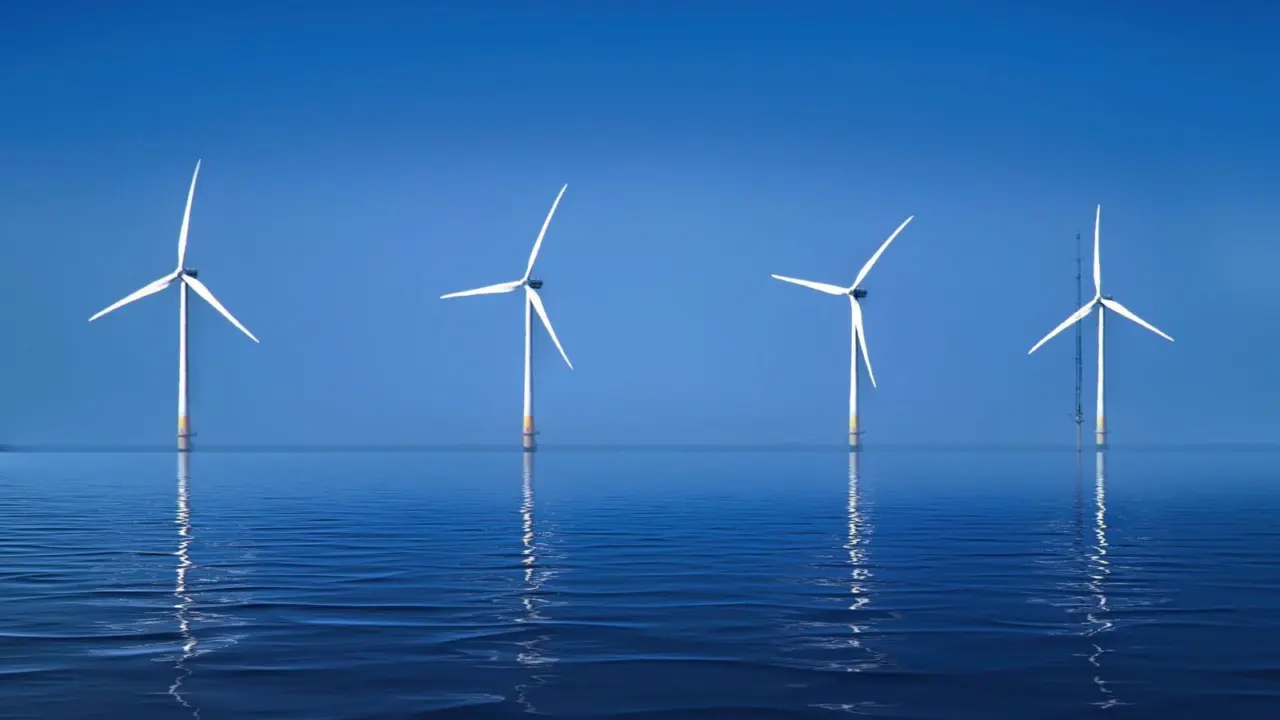
Offshore wind power is electricity generated by turbines standing in open water, on foundations fixed to the seabed or on floating platforms, and sent ashore through undersea cables.
Offshore wind is one entry in the wider family of renewable energy sources, with engineering of its own: very tall turbines, foundations built for the seabed, and cable routes back to shore.
Why developers build wind farms at sea
The U.S. Department of Energy (DOE) reports technical resource data showing more than 4,000 gigawatts (GW) of capacity, or 13,500 terawatt hours (TWh) of generation per year, in federal waters of the United States and the Great Lakes. DOE adds that not all of this resource potential will realistically be developed, but the figure shows the scale of the wind available off the coast.
Location is a second reason. In a DOE article dated August 21, 2024, the department notes that nearly 80 percent of the nation’s electricity demand occurs in the coastal and Great Lakes states, so offshore farms can sit close to the people who use the power. The same article says that in many areas where offshore projects are planned, wind speeds are highest during the afternoon and evening, when consumer demand is at its peak.
Output is the third reason. The International Energy Agency (IEA), in its Offshore Wind Outlook published in November 2019, states that new offshore wind projects have capacity factors of 40%-50%. A capacity factor compares the electricity a plant actually produces over a year with the most it could produce if it ran at full power the whole time.
What an offshore wind turbine looks like
The International Renewable Energy Agency (IRENA) reports that new offshore wind projects use turbines in the 8-12 MW range, in its wind energy overview with data through 2024.
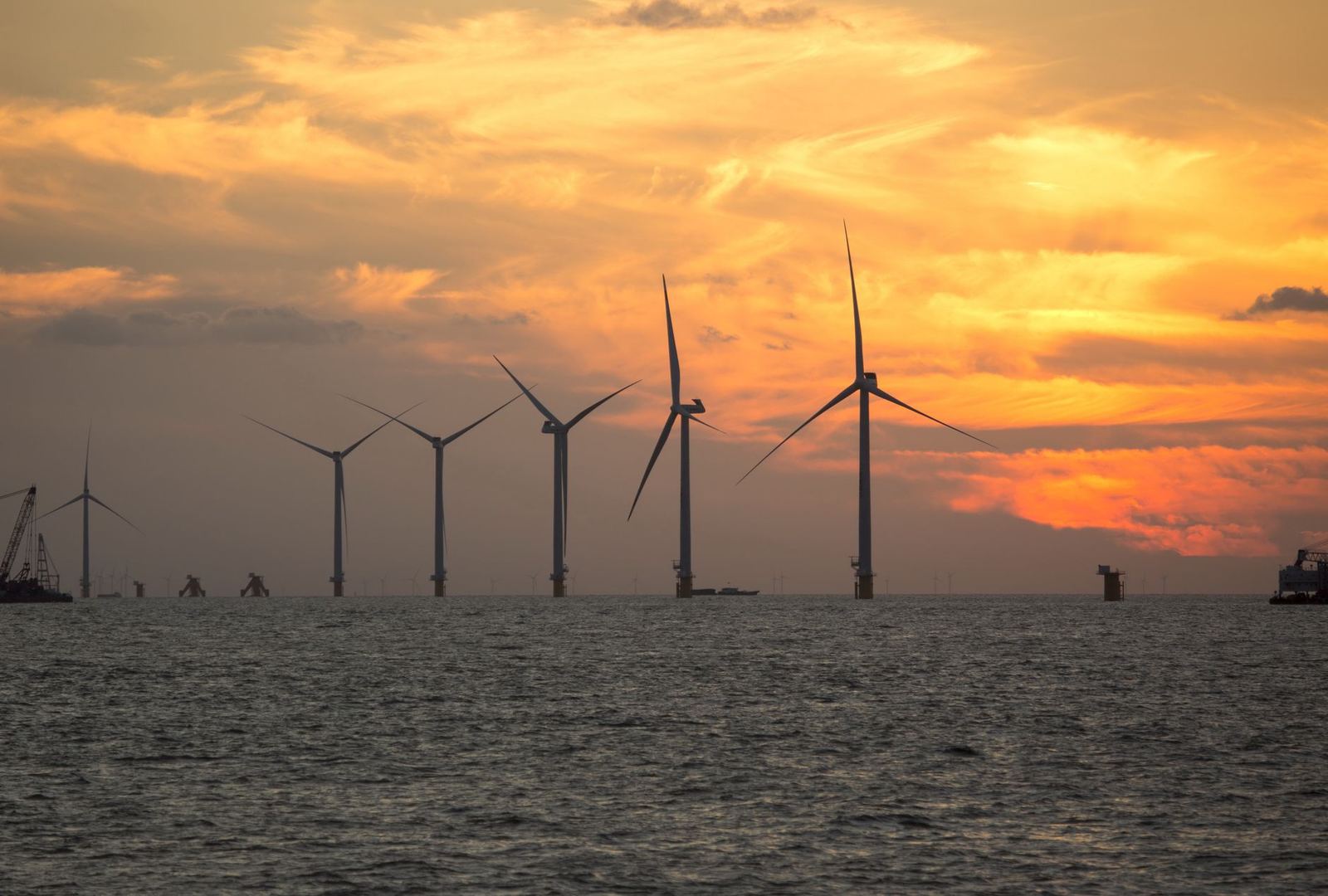
The DOE says offshore turbines can be scaled up to one-and-a-half times the height of the Washington Monument, with blades the length of a football field. Larger turbines can produce greater amounts of energy, meaning that fewer turbines are needed to generate the same amount of electricity, which lowers costs.
Foundations: fixed to the seabed or floating
Water depth decides the foundation. A 2023 DOE strategy report says fixed-bottom substructures are attached to the seabed by piles or suction buckets and are typically deployed in water depths of 60 m or less. In deeper water, floating wind turbines are mounted on buoyant platforms and connected to the seabed using mooring lines and anchors, typically in water depths exceeding 60 m. The report stresses that this depth is not a hard limit, and floating substructures might be deployed in shallower water depending on economic feasibility and siting considerations.
| Foundation family | How it is held in place | Typical water depth |
|---|---|---|
| Fixed-bottom (monopile, jacket, gravity or suction bucket) | Piles or buckets attached to the seabed | 60 m or less |
| Floating (spar-buoy, tension leg platform, semi-submersible, barge) | Mooring lines and anchors | Exceeding 60 m |
Depth ranges and foundation families as described in the DOE report Advancing Offshore Wind Energy in the United States (2023) and the DOE article of August 21, 2024.
The simplest fixed design is the monopile. A Bureau of Ocean Energy Management (BOEM) white paper states that most offshore windfarms worldwide use monopile foundations, a single large steel pipe driven into the seabed. Jackets are lattice frames that spread the load over several legs, and gravity and suction-bucket designs rely on weight or suction to stay in place.
Floating designs matter because deep water holds much of the resource. The DOE says that the bulk of U.S. offshore wind resources lie in water too deep for conventional foundations of large steel piles or lattice structures. Four kinds of floating platforms are spar-buoy, tension leg platform, semi-submersible, and barge. The BOEM paper adds that the mooring lines are connected to anchors, which can be deadweight anchors that sit on the seabed, drag anchors, dynamically embedded anchors, driven piles, or suction caissons.
Cables, substations and grid links
Every turbine in a farm is wired to its neighbours by array cables, and those feed an offshore substation that raises the voltage for the trip to shore. The DOE explains that electricity produced by offshore wind turbines travels back to land through a series of cable systems that are buried in the sea floor.
The export link can use alternating current (AC) or direct current (DC). A 2014 national grid-interconnection study published on energy.gov found that high-voltage alternating current delivery systems comprise the majority of offshore wind power plants in service, but that distance from shore has practical limitations because of cable charging currents. High-voltage direct current (HVDC) delivery does not face the same limit, though it generally requires large converter stations at an offshore platform. The study put the cost crossover between the two at approximately 50 mi (80 km) between the offshore platform and the onshore connection site, and noted that several offshore HVDC systems had been installed in Europe by then.
Connecting to the onshore grid can be as hard as building the farm. The 2023 DOE strategy report states that coastal bulk transmission systems in most U.S. regions are currently not equipped to accommodate large amounts of new offshore wind energy. The same report lists research on HVDC applications and on dynamic cables, which are cables designed to move with floating platforms.
Where capacity stands
The Global Wind Energy Council (GWEC) reported in its 2025 offshore report that the industry installed 8 GW of new capacity in 2024, bringing global offshore wind capacity to a total of 83 GW. The council says that total accounted for 7.3% of global wind capacity as of the end of 2024, that China holds half of the cumulative installations, and that it forecasts annual installations rising from 8 GW in 2024 to 34 GW in 2030.
In the United States, the DOE’s 2024 market report says the first commercial-scale plant, the 132-megawatt South Fork Wind Farm, was fully commissioned on March 14, 2024. The Energy Information Administration (EIA) lists two operating projects at the end of 2024, South Fork at 130 MW and Vineyard Wind 1 at 174 MW, and reports that as of May 2026 developers had plans for about 5,089 MW off New York, Rhode Island and Virginia.
Projects can also fail. The EIA records that in late 2023 developer Orsted canceled the 2,400-MW Ocean Wind 1 and 2 projects in New Jersey, citing rising interest rates, high inflation, and supply chain delays.
Costs have moved in the other direction over the longer run. IRENA reports that the levelized cost of electricity of newly commissioned offshore wind projects fell by 62% from USD 0.208/kWh in 2010 to USD 0.079/kWh in 2024.
Environmental and siting questions
Wind turbines affect wildlife, and offshore sites are no exception. The EIA notes that birds and bats are at risk of injury or death if they fly into turbine blades. DOE-funded research has also targeted the mitigation of environmental impacts, along with the cost of energy, the technical challenges of installation, and grid interconnection, as barriers to offshore development.
Ocean space is shared with shipping, fishing and other users, so siting is as much a planning question as an engineering one. Other renewable options face a similar land-or-sea trade-off, and agrivoltaics shows how solar panels can share a field with crops or grazing animals.
Readers weighing steady against variable supply can also look at geothermal energy, which draws heat from underground rather than from the wind.
Frequently asked questions
What is the difference between offshore and onshore wind?
Onshore turbines stand on land, while offshore turbines stand in the sea or large lakes and need foundations or floating platforms plus undersea cables. Offshore projects also use larger turbines, with IRENA citing the 8-12 MW range for new projects.
How deep can fixed offshore wind foundations go?
DOE describes fixed-bottom substructures as typically deployed in water depths of 60 m or less, with floating platforms typically used beyond that, though it calls the figure a soft boundary rather than a hard limit.
How does offshore wind power reach the grid?
Array cables gather the output, an offshore substation raises the voltage, and buried export cables carry it to shore. Longer routes may use HVDC links with converter stations, while shorter routes commonly use alternating current.
Is offshore wind power available everywhere?
No. It needs suitable wind, seabed or water depth, port access and a grid connection, and projects can be cancelled when costs or financing change, as the 2023 New Jersey cancellations show.