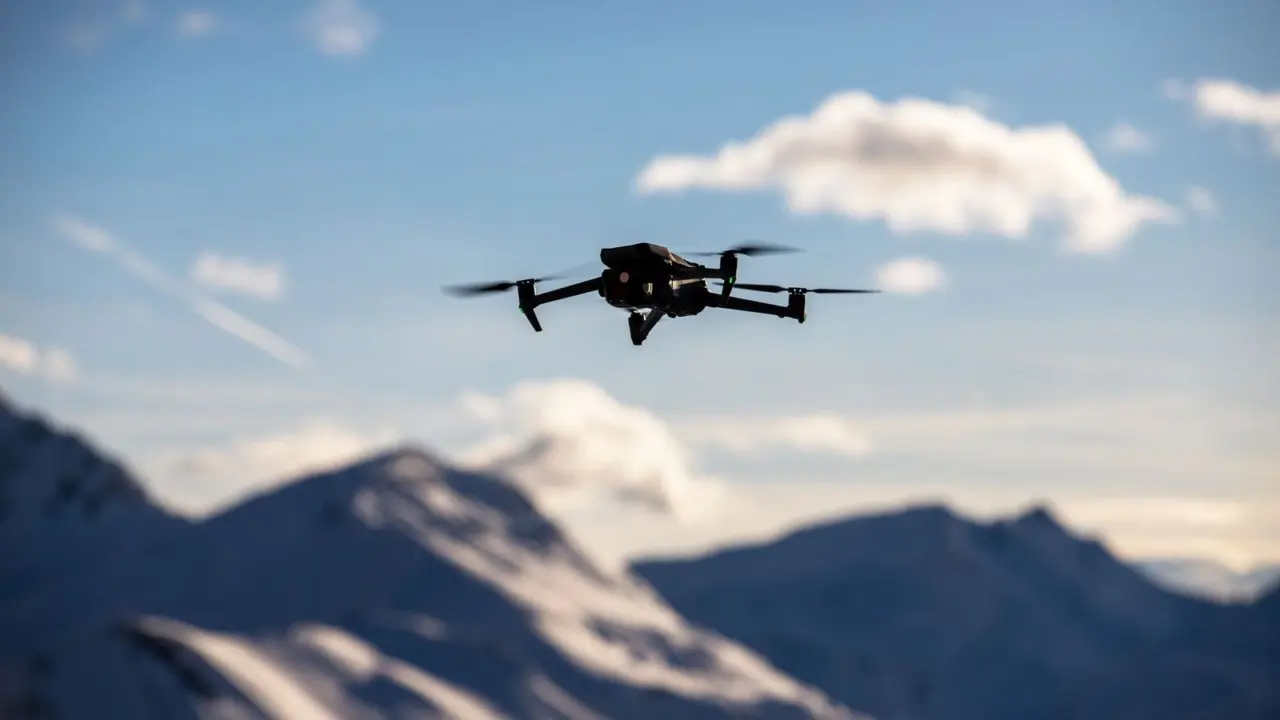
Solar powered drones carry photovoltaic cells on their wings and use that electricity to cut battery drain, stretching flights from hours toward days. The gain is real but bounded by wing area, sunlight and the need to survive the night.
The cells that made small solar drones practical grew out of the thin-film work described in the guide to flexible solar cells, which traces how lightweight photovoltaics moved from laboratories to aircraft.
How solar power extends the flight of a drone
An electric aircraft flies for as long as its stored energy lasts. A solar array changes that arithmetic by feeding electricity into the motor and battery while the sun is up, so the battery drains more slowly or, on a large enough aircraft, not at all during the day. What matters is the balance between the energy the wing collects and the energy the aircraft burns.
NASA Langley published an early analysis of that balance in Technical Paper 1675, written in 1980. Its author concluded that the wing loading of a solar-powered aircraft should be as low as possible, meaning the aircraft should weigh very little for each unit of wing area. The same paper found that the payload capability is quite modest because of the very low wing loading, a trade-off that still shapes solar aircraft today.
Weight is the second pressure. A cell that adds little mass lets the designer keep the wing light, which is why thin, flexible cells attract drone makers. In the 2013 test of a solar Puma AE, AeroVironment’s senior vice president said the cells produce enough power for long-range flight while adding negligible weight, as New Atlas reported on August 14, 2013.
Why thin gallium arsenide cells suited small aircraft
Most rooftop panels use silicon, which is inexpensive but comes in glass-covered modules that are heavy and rigid for a hand-launched aircraft. Gallium arsenide solar cells can be made as a very thin film, and that film can be mounted on a curved or flexible surface such as a wing skin.
Alta Devices, a California company founded in 2007, built its business on that approach. According to Semiconductor Today, the firm fabricated gallium arsenide cells as a film that it lifted off the growth substrate, and the thin-film cell could then be placed on a flexible substrate.
Efficiency matters even more on an aircraft than on a roof, because every extra watt per square metre of wing is a watt that does not have to come from the battery. When the Airware cooperation was announced, Compound Semiconductor reported on 15th October 2014 that Alta Devices held the world record for solar cell efficiency at 28.8 percent.
Flight tests on small drones
The best-documented small-drone demonstration is the solar variant of the AeroVironment Puma AE, a hand-launched small unmanned aircraft. The prototype stayed in the air for a total of nine hours and 11 minutes, according to New Atlas. The standard battery-powered version flew for about two hours, and a new long endurance battery had already lifted the non-solar figure to more than three hours. The solar cells, made by Alta Devices, added the rest.
That result came from a prototype in the research and development phase, with a production version expected the following year. It should be read as a single demonstration, not a guarantee for every drone or every day.
The next year, Alta Devices announced a cooperation with Airware, a company offering hardware, software and cloud services for commercial drones. Compound Semiconductor reported the claim that, by integrating its material onto the wings of a small UAV, flight endurance could be increased by more than four times, and that on certain designs a solar-enabled UAV could fly all day long under sunny conditions. The report named precision agriculture, search and rescue and land surveying as missions that need longer flights than conventional drones provide.
In May 2018, the US Naval Research Laboratory selected Alta Devices to supply flexible solar cells for the Hybrid Tiger. Naval Technology reported on May 17, 2018 that the Hybrid Tiger is a Group-2 autonomous aircraft meant to stay airborne for a minimum of three and a half days. The programme combined flexible solar cells with a hydrogen fuel cell and energy-aware guidance algorithms, and it followed Ion Tiger, a liquid hydrogen-powered fuel cell UAV developed by the same laboratory.
Larger solar aircraft: Helios and Zephyr
Small drones are one end of the range. At the other end, very light, very large aircraft use solar power to stay aloft for weeks. NASA’s Helios prototype, a flying wing with a wingspan of 247 ft, reached 96,863 ft on August 13, 2001, off the coast of Kauai, Hawaii, as recorded in a NASA technical memorandum. The same document states that more than 65,000 solar cells covered the upper surface of the wing, that the cells were about 19-percent efficient, and that the array could produce about 35 kW at high noon on a summer day.
Helios still carried batteries, though. NASA recorded that they were available for limited takeoff power, and the memorandum notes that clouds blocking the sun can be a significant obstacle at takeoff.
The modern successor to this idea is the Airbus Zephyr, a solar aircraft with a wingspan of 25 meters. A first production Zephyr S launched from Arizona on July 11 and completed a maiden flight of 25 days, 23 hours, and 57 minutes, CNBC reported. AVweb added on August 10, 2018 that the previous record belonged to the Zephyr 7 prototype, which remained airborne for more than 14 days in 2010. These stratospheric platforms are covered in the explainer on high altitude pseudo satellites.
| Aircraft | Type | Reported result |
|---|---|---|
| Solar Puma AE prototype | Hand-launched small drone | Nine hours and 11 minutes of continuous flight |
| Helios prototype | Solar flying wing with a 247 ft wingspan | 96,863 ft altitude reached on August 13, 2001 |
The table draws on New Atlas for the Puma AE flight and on the NASA technical memorandum for Helios.
Limits that solar does not remove
The first limit is night. A solar aircraft must either carry enough battery to cross the dark hours or land. The 1980 NASA study judged a flight plan of climbing to store energy by day and gliding at night to be not feasible, because the altitude lost overnight was too great. It also found that rechargeable batteries of that era were too heavy, citing the excessive weight of the batteries as the reason overnight solar flight was out of reach. Lighter batteries have changed that picture, and long Zephyr flights show it, but the energy budget still has to close every day.
The second limit is season and latitude. The same paper pointed to the shorter days and longer nights of high-latitude winter as very unfavorable for solar aircraft. Hybrid Tiger’s design goal of working regardless of latitude or time of year was therefore a deliberate challenge, and its guidance software was meant to manage energy rather than simply fly a fixed route.
Third, a small drone has little wing area. A solar array on a hand-launched aircraft cannot supply a fast, heavy or high-power machine, so solar tends to suit slow, efficient, light-payload missions. Multi-day endurance of the kind the Hybrid Tiger targeted was described as enabling low-altitude communications, atmospheric research and search-and-rescue missions, according to Naval Technology.
What became of the main supplier
Alta Devices was acquired by the Chinese energy group Hanergy, a deal Semiconductor Today dated 14 August 2014. By 2019, under Hanergy’s ownership, Alta was gaining customers in the UAV and space industry such as Boeing and AeroVironment, according to a furloughed employee quoted by pv magazine USA, and the same article, dated Dec 03 2019, said Hanergy-owned Alta had furloughed almost all of its Sunnyvale staff without pay or notice.
This site is an independent explainer. It is not affiliated with Alta Devices, Hanergy, AeroVironment, Airbus or NASA, and it does not sell solar cells or drones.
Frequently asked questions
Can a solar powered drone fly at night?
Only on stored energy. A solar drone charges its battery during the day and draws on it after dark. The Zephyr S completed a maiden flight of 25 days, 23 hours, and 57 minutes, CNBC reported, which means it crossed many nights. Small aircraft with little battery generally have to land when the light fades.
Do solar cells make a drone heavy?
Thin cells add little mass. In the Puma AE flight, the manufacturer’s executive said the gallium arsenide cells added negligible weight, per New Atlas. Heavier rigid panels would cost more flight time than they earn on a small aircraft.
What is the longest solar-powered flight on record?
The longest reported is Zephyr’s 67 days, 6 hours and 52 minutes of continuous flight in the stratosphere, which ended on 28 April 2025, according to AALTO’s announcement on sUAS News. It surpassed the aircraft’s previous record of 64 days in 2022.
Are solar drones used for farming or rescue?
Those missions were the stated targets. The 2014 announcement named precision agriculture, search and rescue and land surveying as work that benefits from longer endurance, and Compound Semiconductor carried the claim. Operating any drone is subject to the aviation rules of the country where it flies.