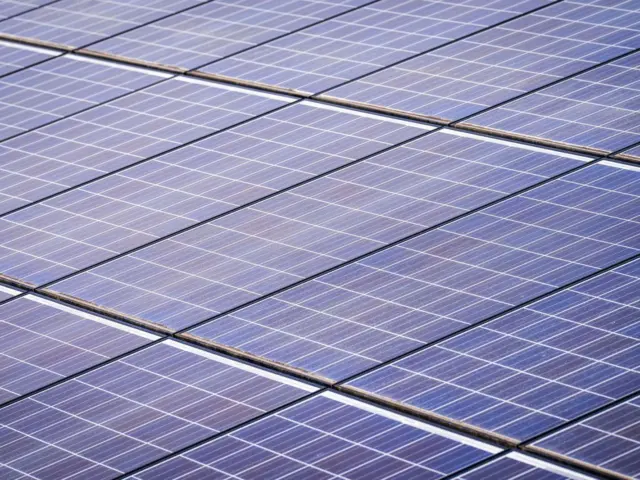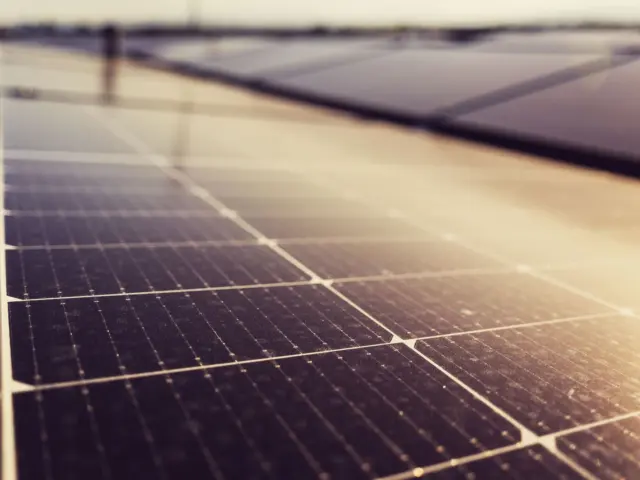
Space solar cells are photovoltaic cells built to power satellites and probes, and the leading designs stack several III-V semiconductor layers to reach a nominal efficiency of 30%, according to NASA’s small-spacecraft guide.
Mass is a constant concern in orbit, because NASA notes that solar cells contribute significantly to spacecraft mass, surface area and cost; lighter, thinner designs are the subject of the wider guide to flexible solar cells.
How a spacecraft turns sunlight into power
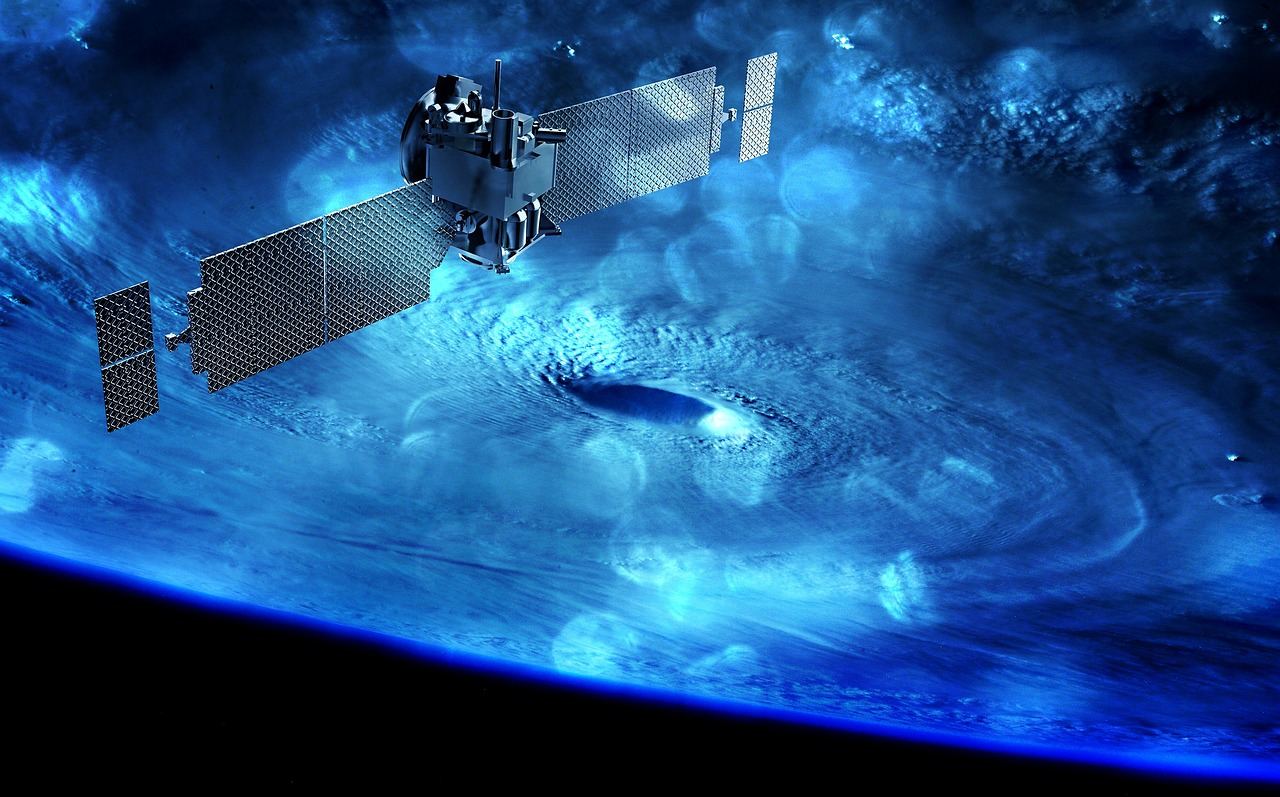
A spacecraft array produces the most power when it faces the Sun squarely. NASA’s small-spacecraft guide states that perpendicular orientation provides maximum generation, and that output drops off by the cosine of the angle as the array tilts away from the Sun. That geometry shapes spacecraft design, because the array has to keep facing the Sun or accept lower output.
Arrays also stop producing in shadow. The same guide lists lack of power generation during eclipse periods among the limits of solar cells, next to reduced effectiveness in deep-space environments and performance loss over the mission lifetime from aging, radiation and contamination. It adds that power systems on small satellites are often overdesigned to accommodate dynamic thermal environments, eclipse durations in low Earth orbit and varying sun angles.
The guide gives another reason arrays matter so much to mission planners: solar arrays are life-limiting components, so their end-of-life performance at operating temperature is a critical metric. A cell that delivers a given output on the launch pad will deliver less after years of exposure, and designers budget for that loss from the start.
From silicon cells in 1958 to stacked III-V cells
NASA describes Vanguard 1 as the world’s first solar-powered satellite, launched on 17 March 1958, and says it remains the oldest artificial object orbiting Earth. A 2021 review in Frontiers in Physics says space solar cells have been used in spacecraft and satellites for over sixty years since the first satellite was launched in 1958, developing from the initial single-junction, low-efficiency silicon cells to today’s high-efficiency multi-junction III-V compound cells.
The jump in performance comes from stacking. NASA’s guide explains that a basic cell is a single layer of semiconductor, most commonly silicon, and that these single-junction cells are inexpensive to make but reach efficiencies of around 20%. Multi-junction cells instead stack several semiconductor layers, each with a bandgap tuned to absorb a specific portion of the solar spectrum, so less of the light is wasted as heat. As of the guide’s update in May 2026, the state of the art for space solar cells is a 3- to 5-junction design built on Group III-V materials such as GaAs, InGaP and germanium, with a nominal efficiency of 30% and a high of 34%.
Efficiency results for earthbound cells are tracked separately, and the page on the solar cell efficiency record covers how those certified results are set. For spacecraft, there is also a ceiling: NASA states that even if triple-junction efficiency improves to the theoretical limit of approximately 40%, the area, mass and storage volume needed to support median power requirements for deep-space exploration remain beyond the point of feasibility.
Flight hardware shows the same efficiency class. NASA’s Dawn mission to the asteroid belt used Emcore’s InGaP/InGaAs/Ge advanced triple-junction cells, which a NASA technical report credits with an average air mass zero efficiency of greater than 27.6%. Air mass zero means sunlight measured outside Earth’s atmosphere, the spectrum a spacecraft actually sees.
What radiation, dust and age do to a cell
In orbit, cells take damage that a rooftop never sees. The Frontiers review states that in-orbit solar cells suffer from irradiation damage due to high-energy protons and electrons in the Earth’s radiation belt and cosmic rays. It identifies radiation-induced displacement damage in the cell lattice as the main reason for degradation, which shortens the lifetime of the photo-generated carriers that produce current. The same review says III-V multijunction cells are the main focus for space application because of their high efficiency and radiation resistance, and it notes that radiation hardening has to be applied before the mission starts.
NASA’s guide lists other ageing factors: radiation exposure, coverglass or adhesive darkening, surface contamination, and mechanical or electrical failures. On another world, dust is the contaminant. Mars rovers Spirit and Opportunity were designed to last only 90 days on the Martian surface, with the expectation that extreme winters and dust storms could cut their missions short. Wind cleared dust from the panels instead. In March 2014 a partial cleaning by Martian wind boosted the electrical output of Opportunity’s array by about 10 percent, and the rover went on to last nearly 15 years. After a later global dust storm, engineers suspected that a layer of dust on the panels was blocking the sunlight needed to recharge its batteries.
Solar power at Jupiter and in the asteroid belt
Sunlight thins quickly with distance, and that sets the practical limit on solar-powered exploration. On 13 January 2016, NASA’s Juno spacecraft became the most distant solar-powered spacecraft, at about 493 million miles from the Sun. The previous record-holder, the European Space Agency’s Rosetta, had peaked at 492 million miles in October 2012. Before Juno, eight spacecraft had operated as far out as Jupiter, and all used nuclear power sources.
Juno’s answer was area. The four-ton spacecraft carries three 30-foot-long solar arrays with 18,698 individual cells. According to JPL, the cells have the potential to generate approximately 14 kilowatts at Earth’s distance from the Sun, but Jupiter is five times farther away and its sunlight packs 25 times less punch, so the arrays generate only about 500 watts there. JPL credits improved solar-cell performance, energy-efficient instruments, a mission design that avoids Jupiter’s shadow and a polar orbit that minimizes radiation.
Dawn shows the same trade on a smaller scale. Its two wings have a total area of 36.4 square meters and, per the Dawn technical report, were projected to produce between 10.3 kWe and 1.3 kWe of end-of-life power across a range of 1.0 to 3.0 astronomical units from the Sun, a low-intensity, low-temperature condition.
| Spacecraft | Distance from the Sun | Array output |
|---|---|---|
| Juno | Earth distance | Potential of approximately 14 kilowatts |
| Juno | Jupiter | About 500 watts |
| Dawn | 1.0 AU | Projected 10.3 kWe at end of life |
| Dawn | 3.0 AU | Projected 1.3 kWe at end of life |
The figures in the table come from NASA JPL’s Juno release and the NASA Technical Reports Server entry for Dawn.
Rollable arrays and thin, flexible cells
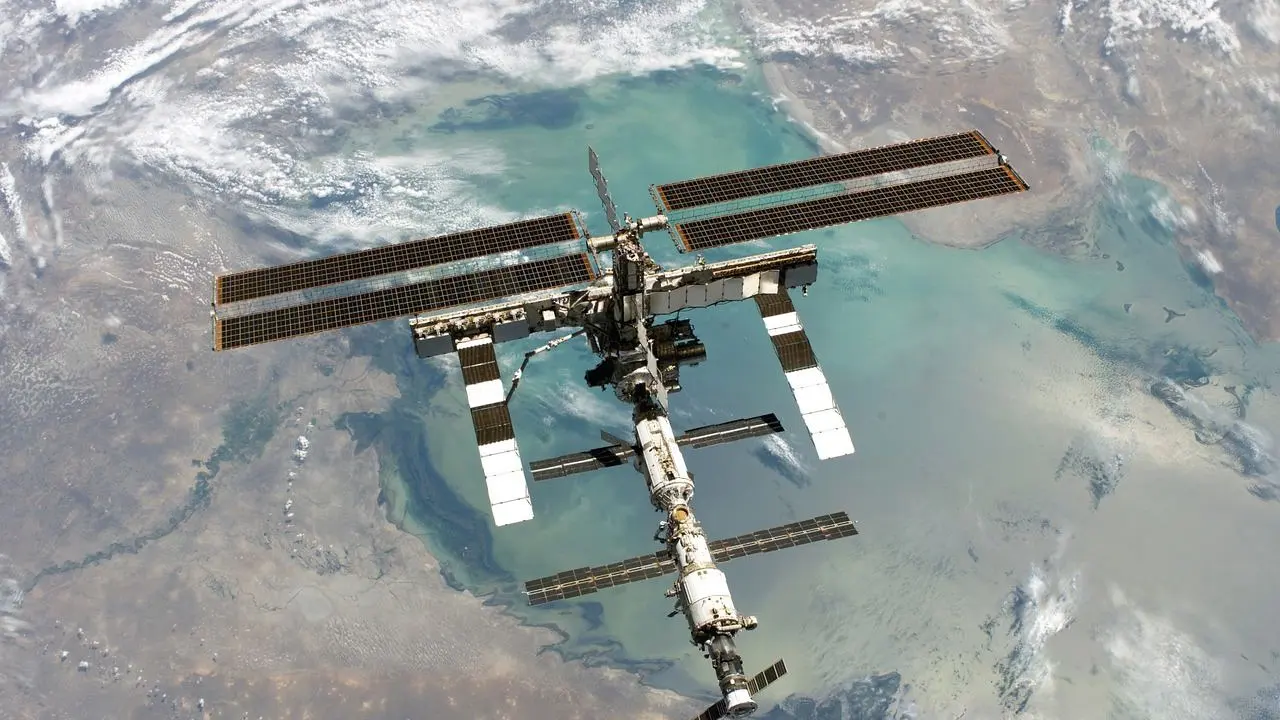
Launch volume pushes designers toward arrays that fold small. On the International Space Station, NASA added ISS Roll Out Solar Arrays, which launch as a cylinder and unfurl like a yoga mat after installation. A technology demonstration in 2017 tested the design on the station, and six of the new arrays were installed outside the station between 2021 and 2023. NASA says they are about half the size of the legacy arrays but are capable of producing about 28 kilowatts of additional power.
Thin cells attack the same problem from the material side. NASA’s guide says modern crystalline silicon wafers are typically 100-200 microns thick, while thin-film layers range from under 1 to a few microns depending on the material, making cells flexible, lightweight and cheaper to make because they use less raw material. The guide also names the catch for spaceflight: manufacturing complexity, temperature sensitivity, and reduced durability and overall power efficiency limit thin-film technology in space for now.
Gallium arsenide, Alta Devices and perovskites
Gallium arsenide is not new to space. MIT Technology Review noted in 2012 that the semiconductor had been used in solar cells on satellites and spacecraft for decades. Alta Devices, a company of Sunnyvale, California, made thin-film GaAs cells and later became part of Hanergy. This site is independent and has no connection with the company.
In December 2018, Semiconductor Today reported that Alta had set a GaAs single-junction efficiency record of 29.1%, certified by CalLab at Fraunhofer ISE. The same report said NASA’s Marshall Space Flight Center had selected Alta for the MISSE-X flight investigation on the space station. Alta engineers worked with Marshall scientists to build an array of nine solar cells, to be returned for evaluation after one year of exposure. The stated goal was to evaluate new cell and package technologies for future missions needing high efficiency, high packing density and very low mass.
The next candidate material is perovskite. NASA’s guide says tandem layers of perovskite on top of III-V stacks are being investigated, and that in October 2025 Ricoh perovskite cells were installed on the HTV-X1 cargo spacecraft at the space station, where they were exposed for two months. How such cells fare on the ground is covered in the guide to perovskite solar cells, where durability is the open question; orbit adds radiation and thermal cycling on top of it.
Frequently asked questions
What are space solar cells made of?
Early satellites used single-junction silicon cells. Current spacecraft arrays mostly use stacked cells of Group III-V materials such as GaAs, InGaP and germanium, according to NASA’s guide.
How efficient are solar cells in space?
NASA’s guide gives a nominal efficiency of 30% and a high of 34% for 3- to 5-junction cells, against around 20% for single-junction cells. Dawn’s panels used cells with an average air mass zero efficiency above 27.6%, a figure from the Dawn report.
Why did Juno need such large arrays?
Jupiter receives far less sunlight than Earth. JPL said the light there packs 25 times less punch, so three 30-foot-long arrays still produced only about 500 watts, as described in the Juno record announcement.
Do all deep-space probes use solar power?
No. JPL said that before Juno, eight spacecraft had reached as far out as Jupiter and all of them relied on nuclear power sources, which is why Juno’s solar power at that range was notable.