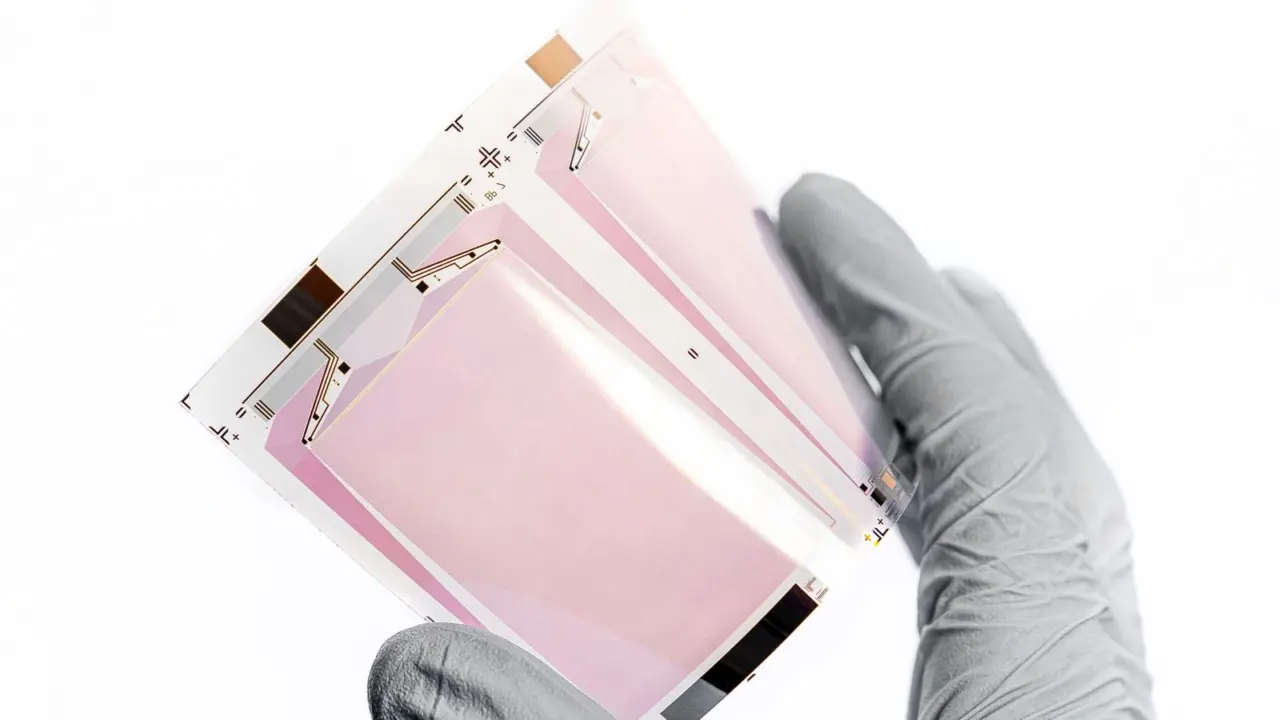
Perovskite solar cells use a thin metal-halide perovskite layer to absorb sunlight. According to the US Department of Energy, small-area devices improved from about 3% in 2009 to over 26%, yet durability and large-scale manufacturing remain unresolved.
Perovskites belong to the thin-film side of photovoltaics covered in the guide to flexible solar cells, and they are also being developed as a partner layer on top of silicon rather than only as a replacement for it.
What a perovskite solar cell is made of
Perovskites are a family of materials that have shown potential for high performance and low production costs in solar cells, according to the Department of Energy. The versions used in photovoltaics are called metal-halide perovskites because they combine organic ions, metals and halogens. One of the more common compositions is methyl ammonium lead triiodide, written MAPbI3, although researchers are exploring different elements and structures to improve stability.
Inside the cell, a thin layer of perovskite absorbs light, and the excited electrons it releases are extracted as electric current. Other material layers above and below the perovskite push those electrons in a single direction toward the metal contacts. The same Department of Energy page calls perovskite cells thin-film because their active layers are much thinner than those of crystalline silicon, the predominant commercial solar cell technology. The broader trade-offs between thin-film designs and silicon panels are covered in the comparison of thin film vs crystalline silicon solar panels.
How cells and modules are manufactured
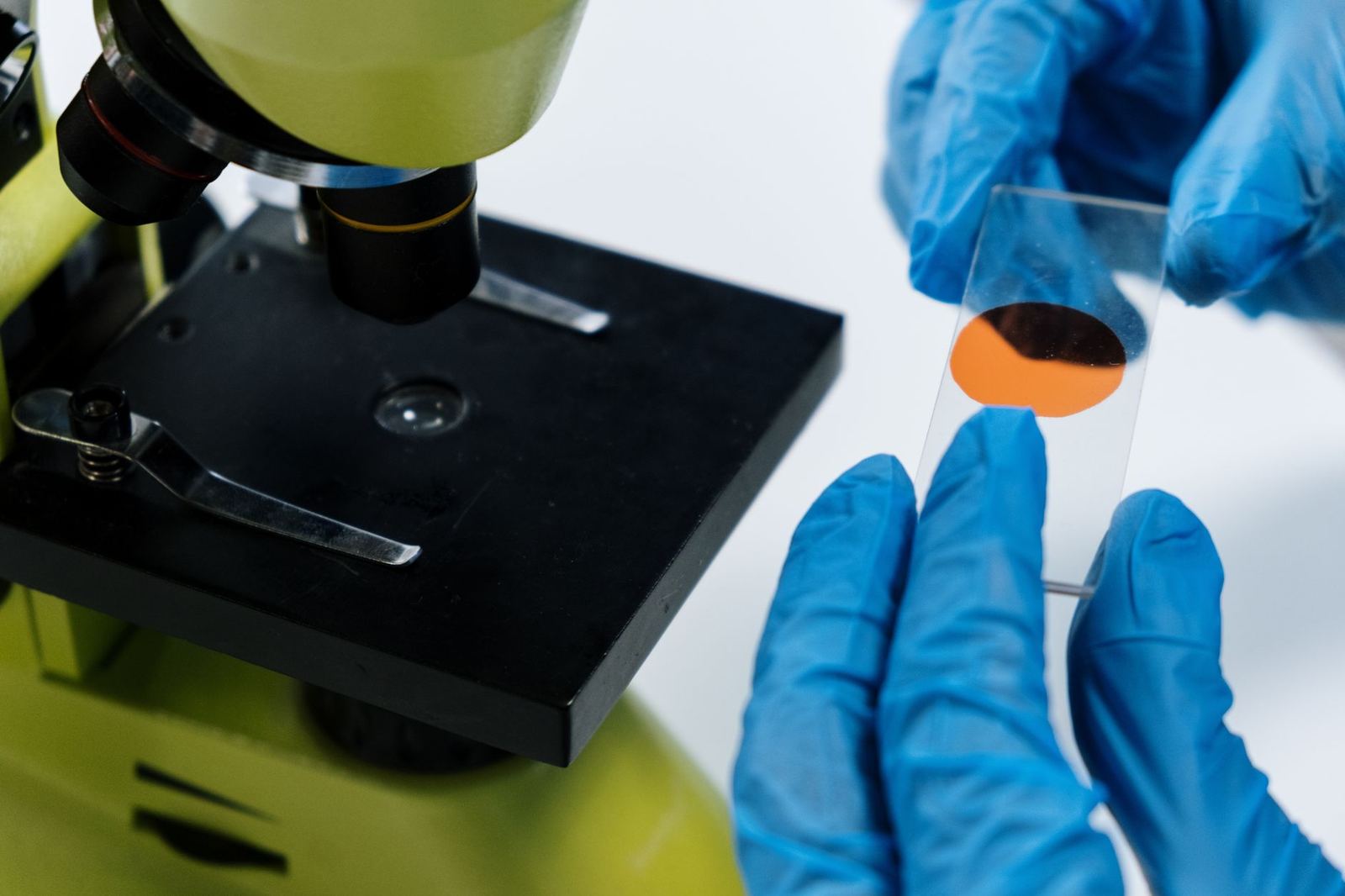
The Department of Energy gives a general overview of the production sequence and notes that, because the technology is still in development, the process may vary widely between research groups. In outline, it runs through four stages:
- Material creation. Precursor salts are mixed to form a perovskite ink solution; if the material is deposited as a vapor, the salts are not mixed until they are deposited together.
- Cell production. An ultra-thin layer of perovskite ink or powder is deposited onto a base and heated to set the film, with other layers added below and above it.
- Module completion. Channels are laser scribed to separate the film into individual cells, further channels carry the electrical contacts, and edge sealant and encapsulant are added for weatherproofing.
- Testing and development. The cell or module is tested to gauge its efficiency and durability.
The cost argument for perovskites rests on these steps. According to the Department of Energy, the cells are made with low-temperature processes and have the potential for ink-based printing of the active layers, which may allow fewer and less expensive process steps and lower capital expenditure. Potential is the operative word: the same page states that perovskite PV is not yet manufactured at scale.
One company example shows how a factory process can look. In a July 2025 report, pv magazine USA relayed that the tandem developer CubicPV applies its perovskite layer by slot die coating, while the other layers use a mixture of solution and vapor deposition with established methods.
Efficiency progress and what the records measure
Most headline figures come from the Best Research-Cell Efficiency Chart. The National Laboratory of the Rockies describes it as a record of the highest confirmed conversion efficiencies for research cells, plotted from 1976 to the present. Entries must be confirmed by independent, recognized test labs, and the measurements use a reference temperature of 25°C. The Department of Energy summary of that chart puts perovskite progress at over 26% on small-area devices of about 0.1 cm2.
Tandems pair perovskite with silicon. A New Atlas report from December 2020 explained why the pairing works: silicon focuses mostly on the red and infrared part of the spectrum, while perovskite excels at green and blue light. The same report traced the tandem record upward in a few years.
| Milestone | Efficiency | Reported |
|---|---|---|
| Silicon-perovskite tandem maximum, five years before the report | 13.7 percent | December 2020 report |
| Tandem maximum earlier in 2020 | 27.7 percent | December 2020 report |
| Team led by Helmholtz-Zentrum Berlin, 1 cm2 sample | 29.15 percent | December 2020 report |
| LONGi two-terminal tandem cell certified by NREL | 34.85% | April 2025 report |
Figures in the table come from New Atlas (December 2020) and pv magazine (April 2025).
The April 2025 result was also described by pv magazine as the first reported certified efficiency above the single-junction Shockley-Queisser limit of 33.7% for a double-junction tandem solar cell. As of that report, the cell was the record for its type, and the Department of Energy page describes perovskite-silicon tandems as having reached almost 34%.
Module-level numbers sit lower than cell records. In July 2025, pv magazine USA reported a perovskite minimodule built by NREL and CubicPV with a certified efficiency of 24.0%, improving on a previous mini module record of 23.9% listed in Solar Cell Efficiency Tables (Version 66).
Stability under heat, humidity and light
Durability is the central open question. A 2022 review in Communications Materials states that stability remains a key obstacle for perovskite cells to compete with established photovoltaic technologies, and that the photovoltaic community relies on the International Electrotechnical Commission (IEC) standard for the minimum stability assessment of any commercialized cell. The Department of Energy lists cell stability and durability first among the four primary challenges it has identified for commercial success, alongside power conversion efficiency at scale, manufacturability, and technology validation and bankability.
The same review explains that three IEC tests, thermal cycling, damp heat and humidity freeze, correlate closely with temperature and humidity, the two crucial factors. It also notes that thermal decomposition of perovskites could occur at the relatively low temperature of 85 °C, a point that matters because damp heat testing exposes modules to heat and moisture together.
Encapsulation is the main response. Cells that pass the IEC tests are dominantly based on a glass-to-glass scheme in which the cell is sandwiched between two glass sheets joined by a polymer encapsulant. In one design the review describes, cells with a back cover glass and a polymer filling survived more than 1800 hours of damp heat testing and 75 cycles of humidity freeze testing, exceeding the requirement of the IEC 61215:2016 standard.
Operating tests give a second angle. The 2025 pv magazine USA article recalled an earlier minimodule with a lab efficiency of 23% and less than 9% degradation after 2,200 hours of operation at 55 C. Such results show progress, but the Communications Materials review also lists limits of evaluating stability within the current IEC framework and stresses the importance of outdoor testing, because laboratory hours are not the same as years on a roof.
Lead content and recycling
Lead halide perovskites are seriously considered for next-generation photovoltaics, and a 2020 review in ACS Omega calls the toxicity of lead used in perovskite devices the major concern. The review adds that the research community is still debating whether the amount of lead in a solar cell really poses a danger, while stating that mitigating lead leakage from damaged devices is of utmost importance.
The authors outline an approach they call ECR, for encapsulate, capture and recycle. Encapsulation by a self-healing material and rigid glass keeps the perovskite away from the external environment, a capture layer in the encapsulant can bind lead that leaks from a damaged device, and recycling of damaged or decommissioned devices helps avoid lead wastage and contamination.
Another response is to change the chemistry. The National Laboratory of the Rockies reports that one of its research centers looked into alternative lead-free perovskite materials and identified a class of materials, such as BiI3, that mimic the electronic structure of the lead-halide perovskite. The laboratory also states that achieving the technology’s potential will require overcoming barriers related to stability and environmental compatibility.
Commercial status and what comes next
On 6 September 2024, eeNews Europe reported that Oxford PV was shipping the first commercial perovskite tandem panels, a 72-cell product with a 24.5% efficiency going to a US customer for a utility-scale installation. The report said the panels were produced at a megawatt-scale pilot line in Brandenburg an der Havel, Germany, and that Oxford PV had been working to commercialise the technology since 2014.
The same report described a double-glass, 60-cell residential-size module from Oxford PV with an efficiency of 26.9%, independently measured and certified by the Fraunhofer CalLab. The module area was just over 1.6 m2, and its weight was under 25 kg.
These examples are early. The Department of Energy says several challenges must still be addressed before perovskites can become commercially competitive. Applications beyond rooftops and power plants, such as satellites, are covered in the guide to space solar cells.
Frequently asked questions
What are perovskite solar cells made of?
The light-absorbing layer is a metal-halide perovskite, a crystalline compound of organic ions, metals and halogens, placed between supporting layers and metal contacts that carry the current out of the cell.
Are perovskite solar panels in commercial use?
In limited form. Oxford PV began shipping tandem panels to a US customer in September 2024, according to eeNews Europe, but the Department of Energy still describes the technology as not yet made at scale.
Why is perovskite combined with silicon?
In a tandem, the perovskite layer sits on top and the silicon beneath it uses colors of light the perovskite does not absorb. According to the Department of Energy, the stack can theoretically be more efficient than either material on its own.
Do perovskite solar cells contain lead?
The commonly studied compositions do. Researchers have proposed capture layers and recycling to limit leakage and waste, and lead-free alternatives remain an active research direction.