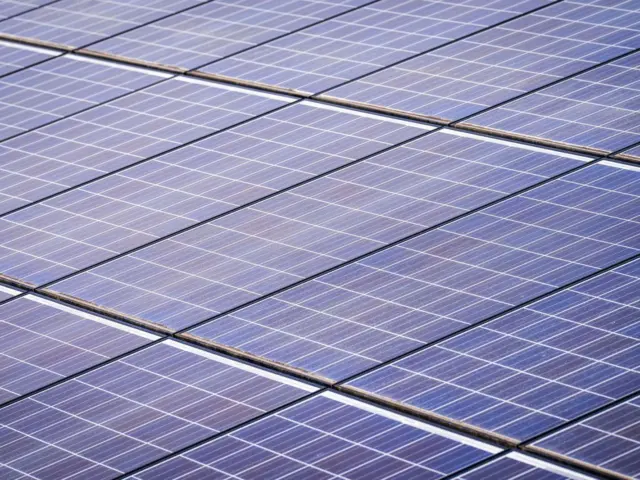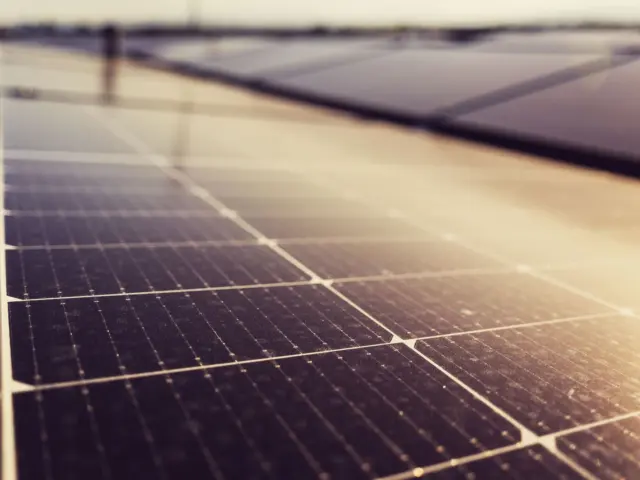
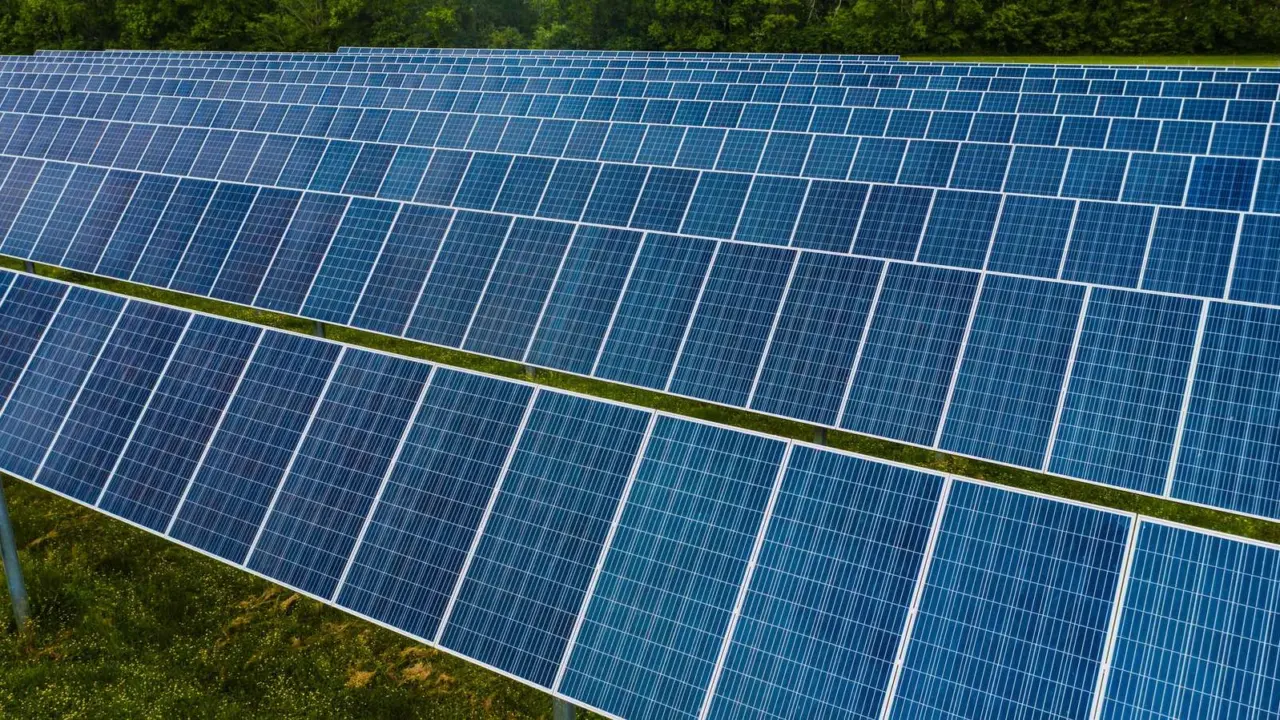
How do solar panels work? Each panel is a set of connected photovoltaic cells whose semiconductor absorbs sunlight, frees electrons, and pushes them out as direct current, which an inverter then converts for household and grid use.
The same physics applies to every panel, from rooftop modules to the thin, bendable designs covered in the guide to flexible solar cells. What changes between them is the material, the layering and the protective packaging around the cells.
Sunlight as a stream of photons
Sunlight is made of photons, tiny packets of energy. According to the U.S. Energy Information Administration, these photons carry varying amounts of energy that correspond to the different wavelengths of the solar spectrum. When they strike a photovoltaic cell, a photon can reflect off the surface, pass straight through, or be absorbed by the semiconductor material. Only the absorbed photons supply energy that can generate electricity.
A photovoltaic (PV) cell, commonly called a solar cell, is a nonmechanical device that converts sunlight directly into electricity. Nothing spins, burns or heats water along the way. The conversion happens inside a thin slab of semiconductor, which is why the process is silent and has no moving parts in the cell itself.
The U.S. Department of Energy describes a semiconductor as a material that conducts electricity better than an insulator but not as well as a good conductor such as a metal. Not every semiconductor can turn light into electricity, a property known as the photovoltaic effect, but several different materials can, each with its own benefits and challenges.
Inside a silicon solar cell
Silicon is, by far, the most common semiconductor material used in solar cells, according to the Department of Energy. A crystalline silicon cell is made of silicon atoms connected to one another in a crystal lattice, an organized structure that makes the conversion of light into electricity more efficient.
The DOE’s PV Cells 101 primer (published December 3, 2019) explains the build. Blocks of crystalline silicon are cut into very thin wafers. Each wafer is processed on both sides to separate the electrical charges and form a diode, a device that allows current to flow in only one direction. The diode is then sandwiched between metal contacts so that the electrical current can leave the cell easily.
The sequence inside the cell runs in four steps:
- A photon with the right energy is absorbed and knocks an electron free from its atom, leaving behind a gap called a hole.
- As the DOE explains, the freed charges move in response to an internal electrical field in the cell, which keeps them from simply falling back together.
- The separated charges collect at the front and back of the cell, creating a voltage similar to the terminals of a battery.
- Metal contacts carry the electrons out through an external circuit, where they do useful work before returning to the cell.
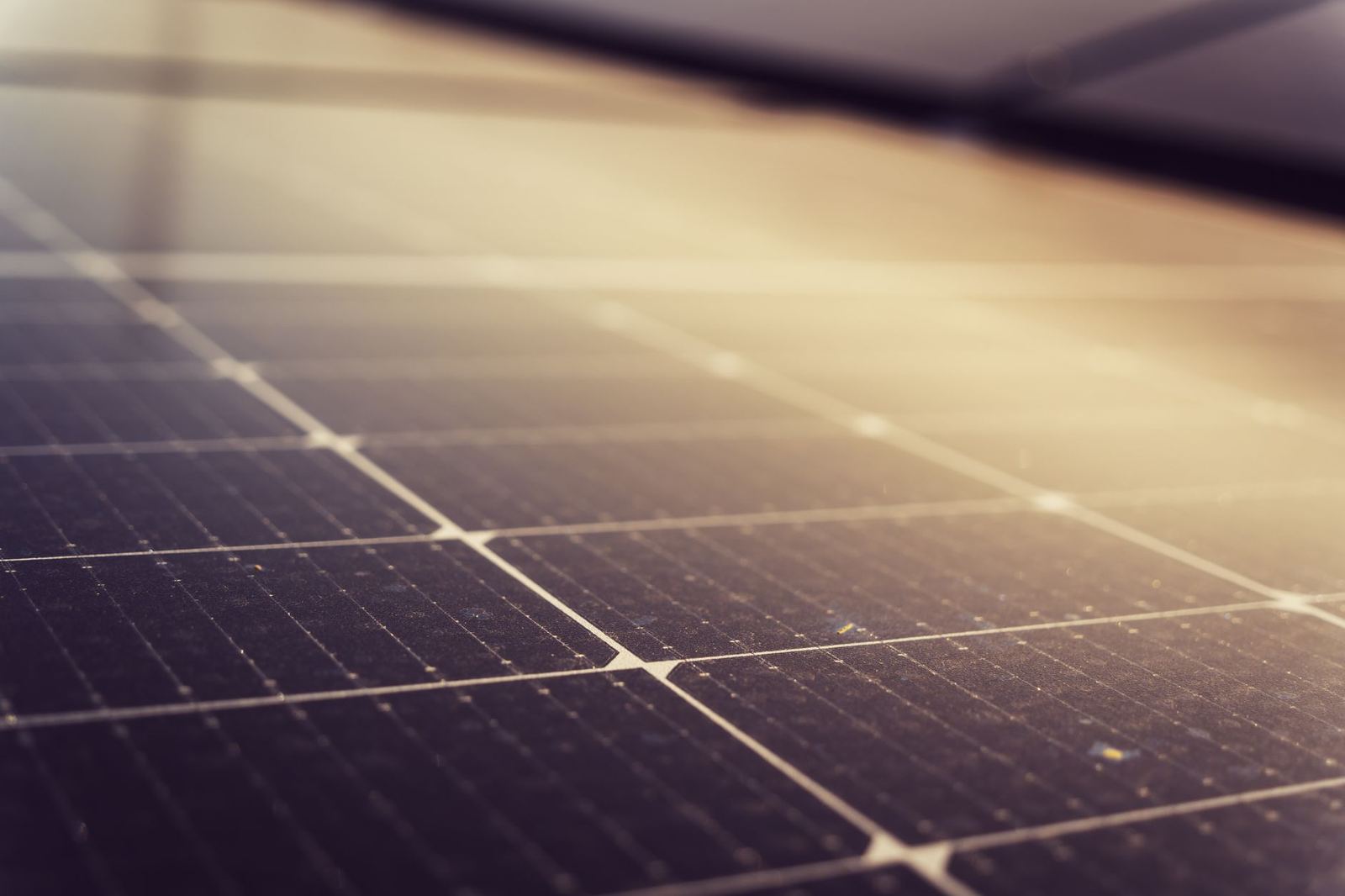
The grid-like lines visible on the front of a cell are those metal contacts. The EIA notes that special treatment of the cell’s surface during manufacturing makes the front more receptive to the freed electrons, so they migrate toward it naturally.
From a single cell to a working array
One cell is a small building block. The EIA states that one PV cell can only produce 1 or 2 Watts, enough for a calculator or wristwatch but not for a home. Manufacturers therefore wire many cells together inside a packaged, weather-tight panel, also called a module. Output rises with the number of cells in the panel and with its surface area.
Panels are then connected in groups called arrays. An array can contain as few as two panels or hundreds, and the number of panels connected determines how much electricity it can generate. The DOE’s primer adds that a typical residential rooftop solar system has about 30 modules.
| Building block | What it is | Role |
|---|---|---|
| Cell | One slice of semiconductor with a junction and metal contacts | Converts absorbed photons into electric current |
| Module (panel) | Many cells wired together under glass or another protective layer | Raises voltage and current to a usable level and shields the cells from weather |
| Array | Several modules connected together | Sets the total output of the system |
| Inverter | Power electronics attached to the array or to each module | Converts direct current into alternating current |
The terms in this table follow the definitions in the EIA explainer on photovoltaics and the DOE’s system design basics.
Why an inverter is part of the system
PV cells generate direct current (DC) electricity, according to the EIA. DC can charge batteries and run devices built for it, but nearly all electricity in transmission and distribution systems is alternating current (AC). Inverters sit on the panels or at the array and convert the DC into AC.
The DOE’s system design page describes two common layouts. A single inverter converts the output of every module and is generally less expensive and easier to cool and service. Microinverters are attached to individual modules and let each panel operate independently, which is useful if some modules are shaded. The same page expects inverters to need replacing at least once in the 25-year lifetime of a PV array.
So-called smart inverters add two-way communication with the electric utility. According to the DOE, that insight helps utilities balance supply and demand, keep the grid stable and lower the chance of outages. Batteries are an optional extra: they store solar electricity so a home can use it at night or when weather blocks sunlight.
What limits how much electricity a panel makes
Not all the light that reaches a cell becomes electricity. The DOE’s performance and efficiency basics lists the main losses, and most sunlight is lost along the way.
- Wavelength: some photons are reflected, some pass through, and some of the absorbed ones turn into heat instead of freeing electrons.
- Recombination: a freed electron can meet a hole and cancel out its contribution to the current, either directly or at an impurity or defect in the crystal.
- Temperature: solar cells generally work best at low temperatures. Higher temperatures cause a slight increase in current but a much larger decrease in voltage.
- Reflection: untreated silicon reflects more than 30% of incident light, so anti-reflection coatings and textured surfaces are used, which is why high-efficiency cells look dark blue or black.
The DOE primer puts a ceiling on the material itself: the maximum theoretical efficiency for a silicon solar cell is about 32%, because of the portion of sunlight silicon is able to absorb above its bandgap. As of that December 2019 primer, the best panels for commercial use had efficiencies around 18% to 22%. The EIA reports that the efficiency of commercially available panels averaged less than 10% in the mid-1980s, increased to around 15% by 2015, and is now approaching 25% for state-of-the-art modules.
The separate article on solar panel efficiency explains what those percentages mean for a roof, including why a lab figure and a real installation differ.
Orientation, tracking and everyday conditions
PV cells and panels produce the most electricity when they directly face the sun, as the EIA explains. Tracking systems can keep panels pointed at the sun, but the EIA calls them expensive, so most systems use panels in a fixed position, usually facing directly south in the northern hemisphere or directly north in the southern hemisphere.
The DOE gives a rule of thumb for the angle. To obtain the highest annual energy output, modules in the northern hemisphere are pointed due south and inclined at an angle equal to the local latitude. For ground-mounted arrays, the DOE says one-axis trackers follow the sun from east to west, while two-axis trackers keep modules pointed directly at it throughout the day, at the price of higher up-front cost and more maintenance.
Panels also work in diffuse light, because photons arrive even when the sun is behind cloud, though the current falls with the light. Heat, dirt and shade lower conversion efficiency outdoors, a point the DOE primer makes when it notes that environmental conditions such as heat, dirt and shade reduce it below lab values.
Other cell materials and how long panels last
Silicon dominates but is not the only option. The DOE primer states that about 95% of solar panels on the market used monocrystalline or polycrystalline silicon as of its 2019 publication. Monocrystalline wafers are a single crystal, in which electrons move more freely, so those panels are more efficient. Polycrystalline wafers contain many crystals and are less expensive to manufacture.
Thin-film cells are made by depositing thin layers of PV material on a supporting material such as glass, plastic or metal. The DOE names cadmium telluride (CdTe) and copper indium gallium diselenide (CIGS) as the two main thin-film semiconductors on the market, and says both need more protection than silicon for long-lasting outdoor operation. A side-by-side look at thin film vs crystalline silicon solar panels compares the two families in detail.
Durability is a strength of silicon. The DOE says silicon modules are expected to last for 25 years or more, still producing more than 80% of their original power after that time. Layering several semiconductors into multijunction cells lets each layer absorb a different part of the spectrum, which is how the highest laboratory efficiencies are reached.
A short history and the scale today
The first practical PV cell was developed in 1954 by Bell Telephone researchers, according to the EIA. From the late 1950s, PV cells powered U.S. space satellites, and by the late 1970s panels were supplying electricity at remote, off-grid locations without power lines. Since 2004, most PV systems in the United States have been grid-connected.
The growth since then is large. Per the EIA, electricity generation at utility-scale PV power plants in the United States increased from 6 million kilowatthours (kWh) in 2004 to about 292 billion kWh in 2025. Small-scale grid-connected systems, mostly on buildings, generated about 93 billion kWh in 2025.
Frequently asked questions
Do solar panels work without direct sun?
Panels absorb photons whenever light reaches them, so they still produce some electricity under cloud. Output drops with the amount of light, and the EIA notes that panels produce the most electricity when directly facing the sun.
Do solar panels store electricity?
No. A panel only generates current while light strikes it. The DOE’s system design page lists batteries as the separate component that stores solar electricity for use at night or in poor weather.
Why do solar panels need an inverter?
Cells produce DC, while most household appliances and the grid use AC. The inverter performs that conversion, and in some systems a microinverter does it at each individual panel.
Does heat make solar panels more productive?
Light is what drives output, and heat works against it. The DOE reports that higher temperatures cause a much larger decrease in voltage than the slight increase in current, so cells generally work best at low temperatures.
What is the difference between a solar cell and a solar panel?
A cell is the individual semiconductor device that converts light to electricity. A panel, or module, is a packaged group of cells connected together, and several panels make up an array.