Battery energy storage is the practice of charging batteries with electricity when supply is plentiful and discharging them when demand is high. On a renewable grid, batteries shift solar and wind output to the hours when people need it.
Storage is one of several tools that make variable generation dependable, alongside the full range of renewable energy sources and the grid upgrades that connect them. This guide explains how batteries work, what jobs they do, how they compare with other storage, and where the market stands.
What battery energy storage does on a grid
An electric grid has to match supply and demand moment by moment. Solar output peaks around midday, but household demand often peaks later. The U.S. Department of Energy describes the problem plainly: without storage, electricity must be generated and consumed at the same time, so grid operators may need to curtail generation when there is more than the system can use. Storage can be filled when generation is high and consumption is low, then dispensed when demand is high.
The U.S. Energy Information Administration (EIA) lists the services that battery systems provide as of its September 2024 analysis: balancing supply and demand, moving electricity from low-price periods to high-price periods, and storing wind and solar output instead of curtailing it. Batteries are not a new source of power. EIA calls them secondary sources, because energy storage systems use more electricity for charging than they provide back to the grid. Some energy is always lost in the round trip, a point the Department of Energy makes directly: storage is never fully efficient, yet it allows energy to be used at different times from when it was generated.
That shifting role matters most where a lot of variable renewable output is added to the grid. The trade-offs between those two technologies are covered in the guide to solar vs wind energy, and batteries are one way both of them can be made to fit daily demand.
How a battery stores and releases electricity
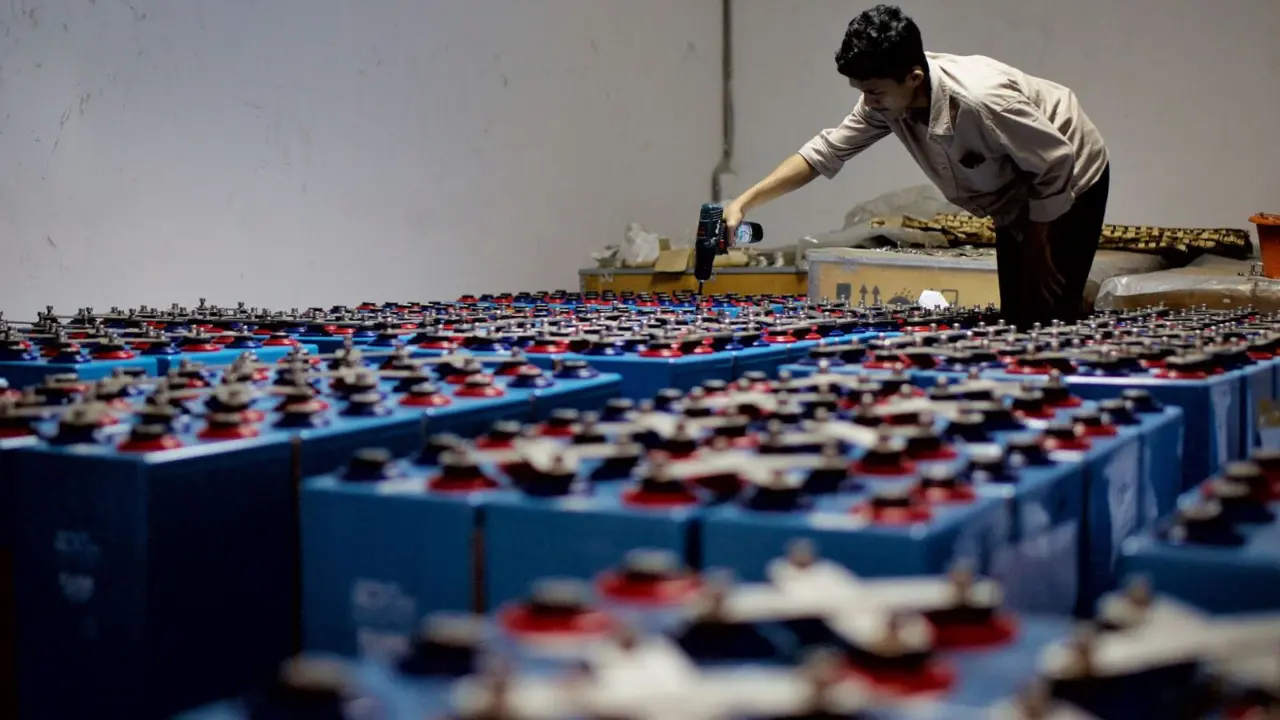
A battery stores energy chemically rather than as electricity itself. The Department of Energy’s Office of Science explains that batteries consist of two electrical terminals called the cathode and the anode, separated by a chemical material called an electrolyte. When the battery is connected to an external circuit, electrons move through the circuit while ions move through the electrolyte. In a rechargeable battery both can move in either direction, which is what lets it charge and discharge repeatedly.
The idea is old. The same Department of Energy page states that batteries were invented in 1800, and notes that the chemistry is still being studied. Rechargeable cells do not reverse perfectly, so over time the lack of a complete reversal can change the chemistry and structure of battery materials, which can reduce performance and safety. This gradual loss is why battery capacity fades with use and age.
Several chemistries exist. The Department of Energy notes that lithium-ion is the most common chemistry for battery cells, with lead-acid, sodium and nickel-based batteries as other common options. EIA reports that most U.S. utility-scale battery energy storage systems use lithium-ion batteries.
Within lithium-ion, the mix has shifted toward lithium iron phosphate (LFP). The International Energy Agency (IEA) reported that LFP reached 80% of new battery storage in 2023. The IEA describes LFP as a lower-cost, less-dense chemistry that does not contain nickel or cobalt, with even lower flammability and a longer lifetime. The IEA adds that energy density is less critical for battery storage than for electric vehicles, which led to the shift toward LFP.
Power, energy and duration
Two numbers describe any storage system. The Department of Energy separates them: energy capacity is the total amount of energy that can be stored, usually in kilowatt-hours or megawatt-hours, while power capacity is the amount of energy that can be released at a given time, usually in kilowatts or megawatts. Dividing energy by power gives duration, the time a battery can deliver full output.
Duration decides what a battery is good for. EIA’s analysis of 2020 data found that battery units built through 2020 could produce their rated power for about 3.0 hours on average before recharging. Short batteries and long batteries do different work:
- Grid services. EIA notes that batteries providing these services discharge power for short periods, sometimes only seconds or minutes, which keeps frequency and voltage steady.
- Daily load shifting. Batteries with a duration between four hours and eight hours are, in EIA’s words, typically cycled once per day to move electricity from low-demand times to high-demand times.
- Firming solar output. The Department of Energy says a small battery can ride through a brief disruption from a passing cloud.
In a solar-heavy region, the daily pattern is simple. EIA explains that daily-cycling batteries can store solar electricity at midday and discharge it during the evening peak when solar output is declining. The IEA frames the same point as a window: batteries are well placed to provide short-term flexibility for periods of 1-8 hours continuously. Storage that must cover days or weeks of low output calls for other technologies, discussed below.
How batteries compare with other storage technologies
Batteries are one of several ways to hold energy. The Department of Energy describes the main families, and the table below summarises how each one stores energy and what limits it.
| Technology | How it stores energy | Main strength or limit |
|---|---|---|
| Pumped-storage hydropower | Water is pumped uphill to a reservoir and later released through a turbine | Mature, but needs suitable landscape, permits and capital |
| Electrochemical batteries | Electricity drives a reversible chemical reaction | Flexible and quick to site; chemistry affects cost and lifetime |
| Thermal storage | Heat is held in a fluid such as molten salt in an insulated tank | Pairs naturally with concentrating solar plants |
| Flywheels | Energy is held in the motion of a heavy rotating wheel | Very fast response, little energy held |
| Compressed air | Air is pumped into tanks or caverns | Suited to large vessels or natural formations |
Table descriptions are drawn from the U.S. Department of Energy’s Solar Integration: Solar Energy and Storage Basics page.
Pumped hydro is the oldest of these at grid scale. The Department of Energy says it is a well-tested and mature storage technology that has been used in the United States since 1929, but that it needs suitable landscapes, lengthy regulatory permits and large initial capital. For the Department of Energy, thermal storage is a family of technologies that use a fluid such as water or molten salt to store heat. Flywheels, in the Department’s words, can quickly provide power, but can’t store a lot of energy.
Batteries gained ground partly because they scale in small steps. The IEA observes that battery storage can be built in a matter of months and in most locations.
Growth and market figures
Battery storage is among the fastest-growing parts of the power sector. Figures below carry the year they describe, because markets move quickly.
In the United States, EIA reported in March 2025 that generators added 10.4 GW of new battery storage capacity in 2024, the second-largest addition after solar. Even so, EIA noted that in 2024 batteries were only 2% of the 1,230 GW of utility-scale generating capacity in the country. As of February 2026, EIA’s inventory shows developers planning 24 GW of utility-scale battery storage for 2026, compared with a record 15 GW added in 2025. The same analysis places the largest share in one state, with 53%, or 12.9 GW, planned in Texas.
Worldwide, the IEA reported that in 2023 deployment was adding a total of 42 GW of battery storage capacity globally, bringing the stock to over 85 GW in use in the power sector. The agency links the growth to falling costs, noting that lithium-ion batteries benefited from 90% cost reductions since 2010, along with higher energy density and longer lifetimes.
The IEA also publishes a forward-looking scenario. In its Net Zero Emissions scenario, battery storage deployment must continue to increase by an average of 25% per year to 2030. That is a scenario requirement, not a forecast of what will happen.
Batteries at home and the safety question
Batteries are also installed behind the meter, in homes and businesses. EIA separates them from grid-scale systems and defines small-scale batteries as having less than 1 MW of power capacity. The Department of Energy notes that solar and storage together can provide backup power during an electrical disruption. How a household’s exported solar power is credited, and whether a battery changes the economics, depends on local tariff rules; the guide to net metering explains one common crediting approach.
Safety is a legitimate concern, and the U.S. Environmental Protection Agency addresses it directly. Its guidance states that lithium battery fires are extremely difficult to extinguish and may reignite hours or days later. The same page also records that improvements in design have led to a decrease in failure incidents per gigawatt hour deployed. A January 2025 fire at the Moss Landing site in California led to a 24-hour evacuation of about 1,200 residents, according to EPA.
EPA’s installation considerations include complying with state and local siting, zoning, marking and permitting requirements, and for large commercial sites it recommends an isolation zone of at least 330 feet, depending on the site during an incident. EPA also points to National Fire Protection Association Standard 855 as the standard for mitigating energy storage hazards. Because these systems involve high-voltage equipment, anyone considering a home battery should rely on a licensed electrician or installer and on local code requirements rather than on general articles.
Frequently asked questions
What is battery energy storage used for?
It moves electricity from times of surplus to times of need, balances supply and demand, and provides short-term grid services such as smoothing output when a cloud passes over a solar plant.
Do batteries generate electricity?
No. EIA classes them as secondary sources because they release electricity that was already produced, and they use more electricity charging than they return.
Which battery chemistry dominates grid storage?
Lithium-ion does, and within it lithium iron phosphate took the largest share of new storage in 2023, according to the IEA.
How long does a grid battery last on one charge?
It depends on its duration. EIA found that U.S. battery units built through 2020 averaged about 3.0 hours at rated power, while daily load-shifting batteries run for four to eight hours.
Are large battery systems safe?
EPA states that lithium fires are hard to extinguish and can reignite, yet reports that failure incidents per gigawatt hour deployed have decreased. Siting rules, monitoring and emergency planning with local responders are the recommended safeguards.